Design by Anastasia Harrison; Photo by Mike Van Tassell
The National Kitchen & Bath Association (NKBA), the world’s leading trade association for the kitchen and bath industry—representing nearly 55,000 North American kitchen and bath industry professionals—has released its 2027 Kitchen Trends Report.
This year’s report finds the kitchen in transition on multiple fronts: layouts are becoming more zoned and deliberate, wellness and climate resilience are moving from afterthought to design priority, and technology is being adopted more selectively.
A survey of 830 respondents from the NKBA community in the U.S. and Canada participated in the survey, with occupations including designers (which make up 62% of responses), dealers/showroom salespeople, dealer specialists, manufacturers, kitchen and bath remodelers/contractors, and architects.
Key findings include the following.
The Great Rebalancing of Space

Courtesy of NKBA
Among the most notable shifts, defined zones, partial walls, and operable partitions are now replacing the fully open-floor plan, with partially concealed kitchens and semi-enclosed layouts cited as up-and-coming. This is a reversal from NKBA’s 2026 report, which identified open layouts as a trend still in its growth phase. Intentional zoning is rated “here to stay” by 81% of designers, while semi-enclosed layouts (46%) and partially concealed kitchens (41%) are named up-and-coming features.
The back kitchen is also back in a big way, with dedicated prep spaces and back kitchens named as up-and-coming layout features, cited by 47% of designers. Generally, function is driving investment, with layout reconfiguration ranking as the second-highest ROI kitchen investment (49%), just behind cabinet upgrades (54%).
Mudrooms and laundry spaces are increasingly integrated into the broader kitchen ecosystem, with 94% of designers agreeing attached mudrooms will be popular over the next three years, and both mudroom (45%) and laundry (43%) spaces are expected to grow.
Generally, the overall kitchen footprint is growing, and 52% of respondents agree it will increase over the next three years, but an important distinction remains: 86% agree the layout itself is simplifying, with less clutter and a more spacious feel, as square footage gets reallocated into the defined zones, back kitchens, and enclosed storage.
Colors and Materials: Quiet Remains the Favorite
While color is returning to the home, neutrals remain the top color choice at 96%, with greens (83%) and blues (75%) following. Warmer hues like yellow landed at 43%, down slightly from 47% in 2026, while reds, including burgundies and bright reds, hold steady at 47%, hinting at a continued appetite for richer color.
Natural materials continue to gain traction, with 34% of designers expecting natural material cabinets (no finish) to be popular. Light-toned cabinetry is favored by 32%, and medium tones are favored by 32%. White oak is the wood of choice for 49% of designers, and 54% agree the kitchen island will feature a distinct color from the rest of the cabinetry. Quartzite and quartz are the two favorite countertop materials (78% and 74%, respectively).
Wellness and Climate Resilience Move to the Forefront
As homeowners increasingly prioritize personal wellness, their preferences in the home are shifting, too. In the kitchen, ventilation is cited alongside water filtration, touchless faucets, and sound-absorbing materials designed to create calmer kitchen environments. Climate resilience has emerged as a clear priority as well, with 65% of designers citing use of leak detection systems and automatic shut-off valves, 62% citing backup power solutions, and 53% pointing to ventilation and air filtration systems.
Lighting As Design, Not Just Function
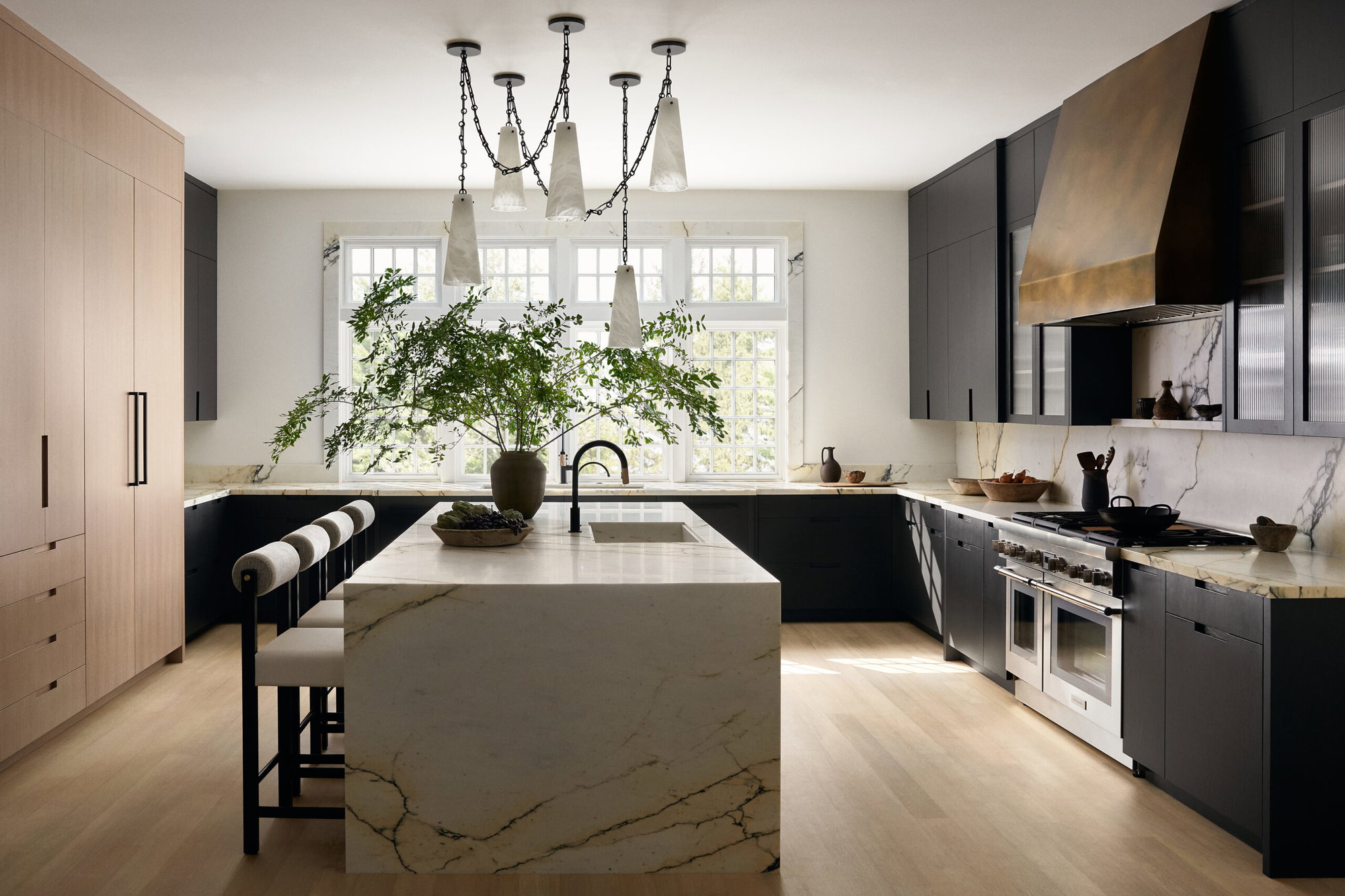
Design by Peter Cardamone; Photo by Brian Wetzel
Lighting is emerging as one of the kitchen’s most expressive elements. Of those surveyed, 84% of designers agree that kitchens will be incorporating multiple layers of lighting to create a more dynamic environment, and 78% agree lighting is increasingly used as a key design feature rather than a purely functional necessity. Connectivity is following suit, with 50% of designers expecting lighting controls to be mobile device-connected in the years ahead.
Designers point to specific fixtures leading that shift over the next three years. Under-cabinet lighting is expected to be popular by 87% of designers, followed closely by interior-cabinet lighting (76%); recessed lights (57%) and floor/path lighting for nighttime (52%) round out the practical end of the list, while sconces and wall lights (48%) and pendant lights (46%) lead the more decorative fixtures.
Additionally, art lights for picture and display lighting (30%), soffit lighting (28%), and chandeliers (23%) show smaller but notable interest, while hydroponic lights for herbs and plants (18%) point to lighting’s growing role in supporting kitchen greenery.
A Measured Approach to AI
Artificial intelligence (AI) is entering the kitchen, but cautiously. According to the report, just 27% of designers expect ovens with food-recognition AI, and 24% expect AI that learns and adjusts to cooking preferences, to be desired in 2027. Air fryers are outpacing convection ovens in anticipated demand, 57% to 46%, and the kitchen continues to move into homeowners’ phones, with mobile alerts for power failure or gas leaks (57%), app-controlled appliances (40%), and Wi-Fi-connected refrigerators (37%) and dishwashers (36%) all gaining traction.
The full report is available at NKBA.org with free access for NKBA members.
Read this next: 3 Key Findings on Whole-Home Design From HPMA & NKBA Joint Study
|
|
|